What is Workforce Engineering — and how do you achieve flow state?
By Will Hackett
Most organisations know they’re not running their workforce as efficiently as they could. They can feel it: the quarterly replanning that takes three weeks, the project that ran over budget with no clear explanation, the AI tools they’re paying for that nobody’s fully using, the constant sense that capacity is either in the wrong place or invisible.
What they’re missing is a framework for thinking about it — and a practice for fixing it.
That framework is Workforce Engineering.
The discipline
Workforce Engineering is the practice of deliberately designing, measuring and optimising how an organisation deploys its labour — human and AI — to produce outcomes.
The word “engineering” is deliberate. This isn’t workforce management, which is about scheduling and compliance. It isn’t HR planning, which is about headcount and org charts. Engineering implies something more active: you’re treating the workforce as a system. A system that can be instrumented, modelled, optimised and improved — with the same rigour you’d apply to your infrastructure or your product.
Like any engineering discipline, it starts with measurement and ends with decisions. The goal isn’t a prettier dashboard. It’s the ability to answer the questions that actually matter:
- Are we deploying our labour against the right outcomes?
- Is our AI investment accelerating delivery or just adding cost?
- What happens to output and cost if we make this hiring decision, or this reallocation?
- Are we capturing the full financial value of the work we’re already doing?
Most organisations can’t answer any of these with confidence. Workforce Engineering is the practice that changes that.
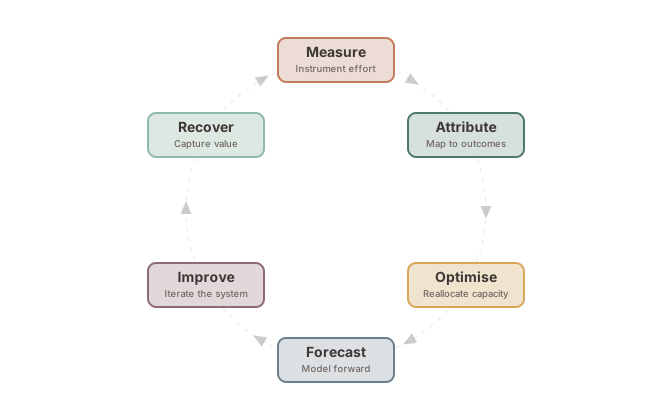
The six practices
Measure. Instrument the workforce properly. Who is working on what, at what cost, toward which outcomes? This is the foundation. Without it, everything else is estimation.
Attribute. Connect effort to outcomes at the project level. Not “we spent £400k on this team last quarter” but “that £400k broke down across these five projects, with this output, and this AI leverage factor.”
Optimise. Make active decisions from the data. Reallocate capacity where it’s needed. Cut spend where it isn’t generating returns. Identify where AI is genuinely accelerating delivery and where it’s burning budget without moving the needle.
Forecast. Project forward with confidence. Model the impact of hiring decisions, team changes and AI investment before you make them, not explain the consequences after.
Improve. Treat it as an iterative discipline, not a quarterly event. The plan you build in January is wrong by February. A live system that reflects reality is worth more than a perfect plan that goes stale.
Recover. Good Workforce Engineering pays for itself. When you can see clearly what your workforce is doing and where the effort lands, you unlock financial value that was always there but invisible: R&D tax relief, CapEx classification, elimination of redundant tooling. Most organisations leave significant money on the table not because they’re negligent, but because they’ve never had the visibility to claim it.
The AI dimension
Workforce Engineering isn’t a new idea. Technical leaders have been trying to connect effort to outcomes for as long as engineering teams have existed.
What’s new is that the unit of labour has fundamentally changed.
AI has broken the assumption that workforce planning is a headcount problem. A team of 14 that used to own a product vertical might now have the effective output of 20 — or 8 — depending on how well they’re using AI tools. Engineers are no longer just individual contributors. They’re orchestrators: defining problems, directing AI agents, reviewing output, handling the work that genuinely requires human judgement.
That means AI spend is no longer a software line in your budget. It’s a form of labour, with the same questions attached as any other: what did it produce, was it worth it, how should we allocate it next period?
You cannot plan headcount without understanding AI capacity. You cannot forecast delivery without knowing how AI spend scales with team activity. Human effort and AI spend are two sides of the same workforce — and organisations that plan one without accounting for the other are working with half the picture.
Workforce Engineering is built for both.
Flow state: the goal
In psychology, flow is the state where capacity and challenge are perfectly matched. No slack, no overload. Everything moving at the highest level it’s capable of. The individual in flow isn’t fighting the work — they’re fully expressed by it.
Organisations can reach an equivalent state. You know you’re approaching it when:
- You can answer “are we getting more efficient?” with data rather than a feeling
- Every pound of labour, human or AI, is traceable to a project and an outcome
- Headcount decisions get made with the same rigour as capital investment decisions
- You can forecast delivery cost before a project starts, not explain overruns after it ends
- Reallocation decisions happen proactively rather than in the post-mortem
- Leadership trusts the plan enough to move faster instead of asking for another review cycle
- You stop losing good people to misallocation because you can see the problem before they start interviewing elsewhere
Most companies are nowhere close. They’re either over-staffed in areas where AI has already taken the load, under-resourced on the priorities that matter, or paying for AI tooling whose impact they can’t measure. The workforce is running — but it isn’t flowing.
Workforce Engineering is the practice that moves you toward flow state.
How to get started
Most organisations approaching Workforce Engineering for the first time make the same mistake: they try to build the perfect system before making any decisions. That’s the wrong order. Start with the decisions you need to make, then work backwards to the data you need to make them.
Start with attribution. The highest-leverage first step is connecting time and effort to projects. Even a rough view of where your people are spending their time — broken down by project, not just by team — gives you the foundation for every other practice. You can’t optimise what you haven’t attributed.
Bring AI spend into the same view. Once you have human effort data, add AI costs alongside it. Not in a separate dashboard — in the same project-level view. The insight comes from seeing both together: this project has three engineers and £12k of monthly AI spend, and here’s what it’s producing.
Build your forecast baseline. Use what you can see now to establish a baseline. What does current allocation look like? What’s your effective capacity given AI leverage? What do project costs look like at current run rates? A baseline is what turns the next quarter’s plan into a comparison rather than a guess.
Close the loop continuously. Workforce Engineering isn’t a quarterly exercise. It’s a live discipline. The organisations that get the most value from it treat it as ongoing — adjusting allocation as priorities shift, tracking AI spend as it scales, recalculating forecasts as reality diverges from plan.
Recover what you’ve earned. Once you have clean project-level attribution, apply it to financial recovery. Which engineering work qualifies as R&D? Which AI spend is capital investment under accounting standards? Your system of record becomes the source of truth for your accountant — and the numbers that were previously estimated become defensible.
Workforce Engineering is the practice. Flow state is the goal. The distance between where most organisations are today and where they could be is almost entirely a measurement problem — which means it’s an engineering problem.
And engineering problems have solutions.